
Vaccine impact: rubella birth defects drop by almost 75% since 2012
Vaccine impact: rubella birth defects drop by almost 75% since 2012
30 July 2026
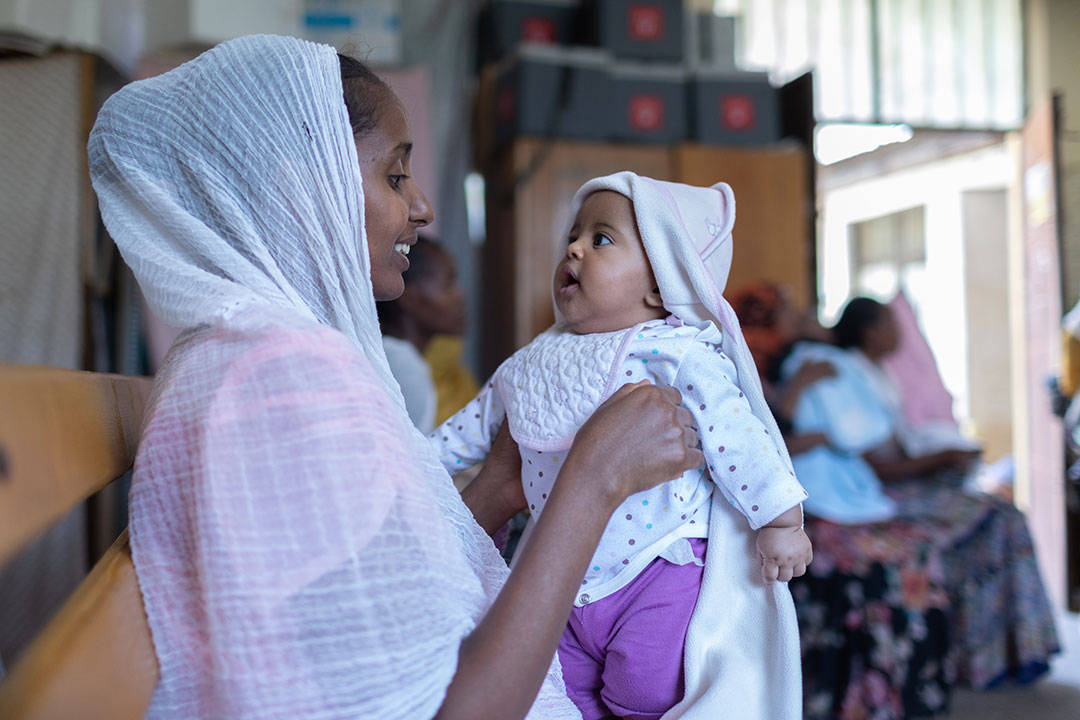
Gavi/Ethiopia/Mulugeta Ayene
New modelling by the US CDC shows the impact that increasing access to the rubella vaccine has had on cases of congenital rubella syndrome.
Announcements
IFFIm impact
IFFIm has dispersed $222 million to Gavi to fight rubella and measles.
At a glance
- Access to the rubella vaccine has increased substantially over the past decade. Global coverage for the first dose of the vaccine has risen from 39% of children in 2012 to 73% in 2024. In the same timeframe, the number of countries providing it free of charge has risen from 132 to 194.
- New modelling estimates that this has driven a substantial reduction in cases of congenital rubella syndrome, falling by 73.5% from 2012 to 2024. One hundred and seventeen countries have now eliminated the disease.
- Congenital rubella syndrome results from maternal infection with rubella virus during pregnancy and can cause permanent deafness, eye and heart defects in babies.
Cases of congenital rubella syndrome have fallen by almost three quarters since 2012, according to figures published by the US Centers for Disease Control and Prevention (CDC).
The fall in birth defects tracks the growing coverage of the vaccine, now part of routine childhood immunisation in 179 of the world's 194 countries, up from 132 in 2012.
Congenital rubella syndrome can cause serious long-term birth defects. Children with the syndrome can suffer hearing impairments, eye and congenital heart defects, as well as developmental delay.
Wider reach
Rubella is a mild enough infection in children and adults to pass unnoticed.
However, it can be dangerous if women are infected when they are pregnant, causing miscarriage, stillbirth or the group of birth defects known as congenital rubella syndrome (CRS).
Congenital rubella syndrome can cause serious long-term birth defects. Children with the syndrome can suffer hearing impairments, eye and congenital heart defects, as well as developmental delay.
In 2012, when accelerated rubella control efforts began, 132 of the world’s 194 countries offered rubella vaccine as part of routine childhood immunisation.
By 2024, that had risen to 179 countries. Coverage increased with it: the share of infants aged 12 to 23 months receiving a first dose rose from 39% in 2012 to 73% in 2024.
Modelled estimates in the report suggest cases of congenital rubella syndrome fell by 73.5% over the same period, from around 101,000 a year to roughly 27,000.
The number of countries verified as having eliminated rubella has also climbed, from 84 in 2019 to 117 by the end of 2024. That is 60% of all countries.
Where the gap sits
However, by 2024, 15 countries had still not introduced the vaccine. Between them, they are home to about 21 million infants aged 12 to 23 months, or 16% of the world’s babies. Most are low-income or affected by conflict, among them Afghanistan, Chad, the Democratic Republic of the Congo (DRC), Ethiopia, Niger, Nigeria, Somalia and South Sudan.
The imbalance shows up sharply by region. Coverage in the African Region stood at 37% in 2024, against 96% in the South-East Asia Region. The African Region accounted for 89.1% of the world's estimated cases of congenital rubella syndrome that year.
Coverage across low-income countries as a group was 30% in 2024. That average includes the countries where the vaccine is not offered at all and coverage is therefore zero.
However, among low-income countries that have introduced it, coverage reached 82%, slightly above the 81% recorded across lower middle-income countries.
The obstacle is getting the vaccine into the schedule, not delivering it once it is there.
Cases rose again in 2024
Reported rubella cases dropped steeply for most of the period, from 94,277 in 2012 to 18,881 in 2022, before rising again to 31,593 in 2024.
The report attributes that rise to three countries. Chad and Nigeria had not introduced the vaccine and South Africa was in the middle of rolling it out. South Africa reported 15,100 cases in 2024 and Chad 6,177.
Reported cases of congenital rubella syndrome also went up, from 302 in 2012 to 611 in 2024.
The authors say this most likely reflects better detection rather than more disease, following the expansion of surveillance in several large countries including Afghanistan, Bangladesh, India, Indonesia and Pakistan.
What happens next
Nigeria and the Democratic Republic of the Congo (DRC) have been introducing the vaccine during 2025 and 2026, which the report expects to cut the number of unprotected infants substantially.
Nigeria began in October 2025 with an integrated measles, rubella and polio campaign run by its National Primary Health Care Development Agency with support from WHO, UNICEF, Gavi, Rotary and the Gates Foundation. It is designed to reach around 106 million children, and moved into its southern phase in January 2026.
Policy has shifted too. Until 2024, WHO advised countries to introduce rubella vaccine only once they had reached and could sustain high measles vaccination coverage.
Its Strategic Advisory Group of Experts dropped that condition in 2024 and now recommends that every country introduce it. In 2025 the Eastern Mediterranean Region adopted an elimination goal, meaning all six WHO regions now have formal targets.
Reassuringly, no country that has achieved rubella elimination has seen endemic transmission return.
The authors conclude that global elimination is feasible. Achieving it depends on the remaining countries introducing the vaccine and on all countries continuing to invest in immunisation and surveillance systems.
Share this article
Restricted Access Library
 The material in this Restricted Access Library is intended to be accessed only by persons with residence within the territory of a Member State of the European Union and is not intended to be viewed by any other persons. The material in this Restricted Access Library is provided by IFFIm for information purposes only and the materials contained herein were accurate only as of their respective dates. Certain information in the materials contained herein is not intended to be, and is not, current. IFFIm accepts no obligation to update any material contained herein.
Persons with residence outside the territory of a Member State of the European Union who have access to or consult any materials posted in this Restricted Access Library should refrain from any action in respect of the securities referred to in such materials and are otherwise required to comply with all applicable laws and regulations in their country of residence.
By clicking Access restricted content: DYNAMIC-LINK-TEXT I confirm that I have read and understood the foregoing and agree that I will be bound by the restrictions and conditions set forth on this page.
The materials in this Restricted Access Library are for distribution only to persons who are not a "retail client" within the meaning of section 761G of the Corporations Act 2001 of Australia and are also sophisticated investors, professional investors or other investors in respect of whom disclosure is not required under Part 6D.2 of the Corporations Act 2001 of Australia and, in all cases, in such circumstances as may be permitted by applicable law in any jurisdiction in which an investor may be located.
The materials in this Restricted Access Library and any documents linked from it are not for access or distribution in any jurisdiction where such access or distribution would be illegal. All of the securities referred to in this Restricted Access Library and in the linked documents have been sold and delivered. The information contained herein and therein does not constitute an offer for sale in the United States or in any other country. The securities described herein and therein have not been, and will not be, registered under the U.S. Securities Act of 1933, as amended (the "Securities Act"), and may not be offered or sold in the United States except pursuant to an exemption from, or in a transaction not subject to, the registration requirements of the Securities Act and in compliance with any applicable state securities laws.
Each person accessing the Restricted Access Library confirms that they are a person who is entitled to do so under all applicable laws, regulations and directives in all applicable jurisdictions. Neither IFFIm nor any of their directors, employees, agents or advisers accepts any liability whatsoever for any loss (including, without limitation, any liability arising from any fault or negligence on the part of IFFIm or its respective directors, employees, agents or advisers) arising from access to Restricted Access Library by any person not entitled to do so.