
Twenty years of IFFIm: the power of finance to save lives
Twenty years of IFFIm: the power of finance to save lives
20 March 2026
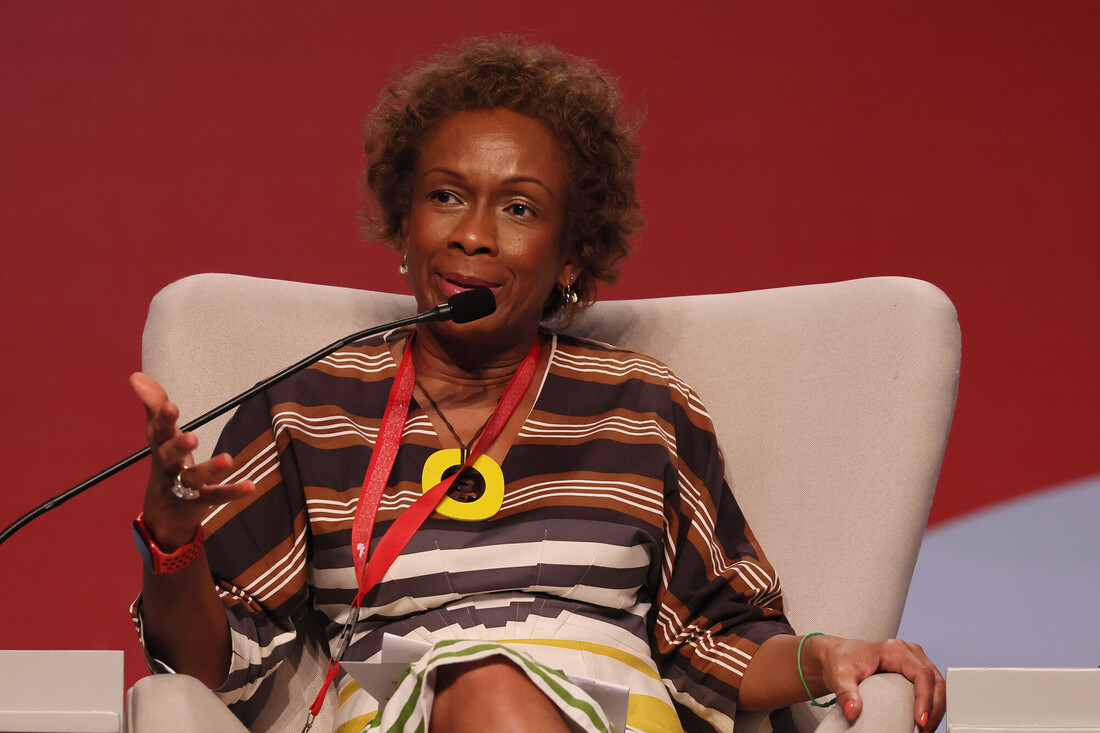
Marie-Ange Saraka-Yao at an event in Abidjan in the Ivory Coast. Credit: Jemal Countess
In a packed parliamentary chamber in Brasília, Gavi’s departing Chief Resource Mobilisation & Growth Officer Marie-Ange Saraka-Yao watched lawmakers debate whether Brazil should commit to a global financing instrument most had never heard of. The questions were pointed. The scepticism was real. Why commit public funds so far into the future?
Announcements
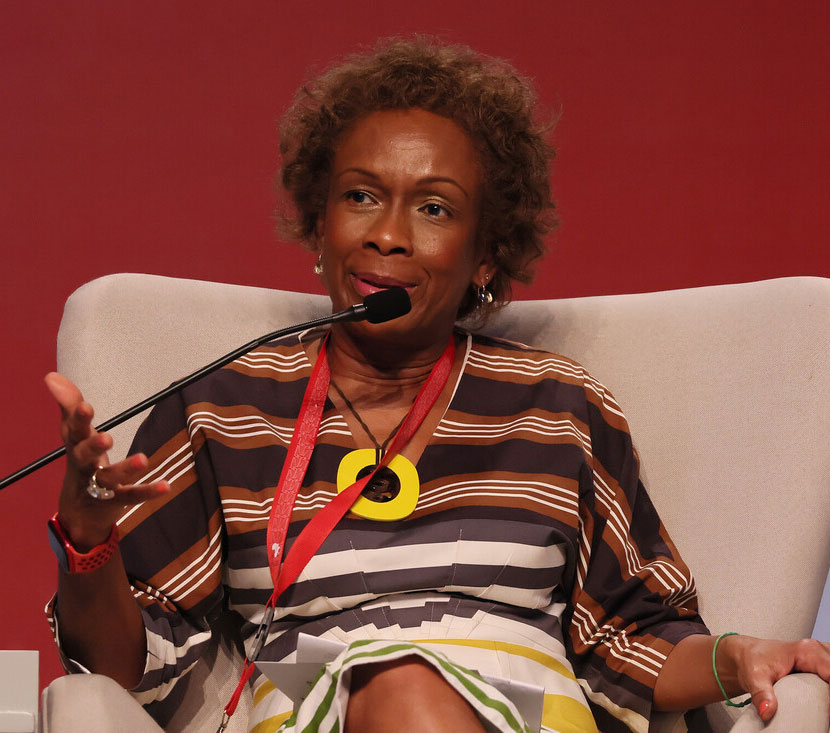
For Marie-Ange, then already years into championing IFFIm, the moment captured everything the instrument demands, and everything it makes possible. “We had the pledges. But the children couldn’t wait 10 years,” she said.
That tension – one between budget restraints and human urgency – has defined IFFIm’s story since its creation in 2006. And as IFFIm marks its 20th anniversary in 2026, it is also a story of how leadership helped turn a highly technical idea into one of the most influential tools in global health finance
A leap of faith
IFFIm was launched to answer a deceptively simple question: how do you move faster when lives are at stake? By issuing bonds backed by long-term sovereign pledges, IFFIm enabled Gavi, the Vaccine Alliance to access funds upfront, years before traditional aid would arrive.
In its early years, before Gavi had a formal replenishment cycle, IFFIm gave a massive boost to global immunisation efforts and demonstrated that innovative finance could deliver realworld impact. But it was also complex. To many policymakers, it sounded abstract, full of legal frameworks, balance sheets, and bond terminology.
“In the beginning, we made IFFIm sound much more complicated than it needed to be,” said Saraka-Yao. “But this was never about basis points. It was about speed, certainty, and saving lives.”
From the start, political leadership mattered. IFFIm was born during the UK’s G7 presidency, backed by leaders willing to take a leap of faith. That same willingness would later prove essential as the instrument sought to grow beyond its founding donors.
Making IFFIm work in the real world
When Marie-Ange joined Gavi in 2011, now serving as Chief Resource Mobilisation & Growth Officer, IFFIm was at another inflection point. Gavi had introduced a structured five-year replenishment cycle, and the role of IFFIm needed to evolve.
A senior executive with a 20-year track record in strategic leadership, policy development, innovative finance and resource mobilisation, Marie-Ange brought both technical expertise and political fluency. Her leadership has been instrumental in helping Gavi raise nearly US$ 45 billion in pledges by 2025. As Gavi’s lead negotiator with G7 and G20 leaders, corporations, and high-net-worth individuals, she helped expand and diversify Gavi’s investor base using instruments like IFFIm, the Advanced Market Commitment, and the Gavi Matching Fund in complementary ways.
“Donors would ask me: ‘You want us to commit now for something that may happen years from today?’ And I would tell them – yes, because that’s exactly how we prevent the next crisis,” she said.
Under Marie-Ange’s leadership, IFFIm shifted from being seen primarily as a front-loading mechanism to becoming a source of strategic flexibility, supporting long-term vaccine procurement, market shaping, and rapid response when the unexpected hit.
That flexibility proved decisive. IFFIm financing helped accelerate Ebola vaccine development in 2015. It provided surge capacity during COVID-19. It supported the early stability of Coalition for Epidemic Preparedness Innovations (CEPI) when the organisation was still finding its footing.
Nowhere was Marie-Ange’s persistence more evident than in Brazil. Although Brazil made an initial political commitment to IFFIm in 2006, it took several years of engagement – across legal, parliamentary, and budgetary systems – before the pledge became operational in 2018. “New donors don’t just sign on,” she said. “You have to help them make it work within their own system – and stay with them until it does.”
From the IFFIm Board’s perspective, that ability to translate complexity into conviction has been central to the instrument’s success.
“Marie-Ange has an exceptional ability to explain IFFIm’s advantages to donors – clearly, credibly, and in a way that connects finance to real-world impact. She helped position IFFIm as a smart, strategic choice, not just a generous one,” said Ken Lay, former Chair of the IFFIm Board of Directors.
The future: stronger, broader and more human
Today, donors still engage with IFFIm for the economic benefits to their budgets but also for different reasons. Some value its role in shaping markets and reducing vaccine prices, including for pentavalent and HPV vaccines. Others rely on its surge capacity – the reassurance that financing can move at the speed of a health emergency.
Increasingly, IFFIm is also seen as a platform for the future, with potential roles in supporting new vaccines and addressing diseases like malaria and tuberculosis that require large upfront investment.
As IFFIm enters its third decade, it does so with momentum, including an ongoing strategic review to ensure IFFIm continues to be attractive to donors and responsive to Gavi’s needs. Far from being a legacy instrument, it is poised to become even stronger and more relevant, helping Gavi and its partners meet the challenges of the next 20 years and beyond.
For Marie-Ange, that future is also personal. Just weeks ago, she was back in Brazil – one of her final donor missions – reflecting on a relationship that took years to realise and now stands as a testament to what persistence and leadership can achieve.
“If there’s one thing I hope people remember, it’s that finance should never be the reason we fail to save lives,” she said. “IFFIm showed what’s possible when we’re willing to think differently, and act boldly.”
Share this article
Restricted Access Library
 The material in this Restricted Access Library is intended to be accessed only by persons with residence within the territory of a Member State of the European Union and is not intended to be viewed by any other persons. The material in this Restricted Access Library is provided by IFFIm for information purposes only and the materials contained herein were accurate only as of their respective dates. Certain information in the materials contained herein is not intended to be, and is not, current. IFFIm accepts no obligation to update any material contained herein.
Persons with residence outside the territory of a Member State of the European Union who have access to or consult any materials posted in this Restricted Access Library should refrain from any action in respect of the securities referred to in such materials and are otherwise required to comply with all applicable laws and regulations in their country of residence.
By clicking Access restricted content: DYNAMIC-LINK-TEXT I confirm that I have read and understood the foregoing and agree that I will be bound by the restrictions and conditions set forth on this page.
The materials in this Restricted Access Library are for distribution only to persons who are not a "retail client" within the meaning of section 761G of the Corporations Act 2001 of Australia and are also sophisticated investors, professional investors or other investors in respect of whom disclosure is not required under Part 6D.2 of the Corporations Act 2001 of Australia and, in all cases, in such circumstances as may be permitted by applicable law in any jurisdiction in which an investor may be located.
The materials in this Restricted Access Library and any documents linked from it are not for access or distribution in any jurisdiction where such access or distribution would be illegal. All of the securities referred to in this Restricted Access Library and in the linked documents have been sold and delivered. The information contained herein and therein does not constitute an offer for sale in the United States or in any other country. The securities described herein and therein have not been, and will not be, registered under the U.S. Securities Act of 1933, as amended (the "Securities Act"), and may not be offered or sold in the United States except pursuant to an exemption from, or in a transaction not subject to, the registration requirements of the Securities Act and in compliance with any applicable state securities laws.
Each person accessing the Restricted Access Library confirms that they are a person who is entitled to do so under all applicable laws, regulations and directives in all applicable jurisdictions. Neither IFFIm nor any of their directors, employees, agents or advisers accepts any liability whatsoever for any loss (including, without limitation, any liability arising from any fault or negligence on the part of IFFIm or its respective directors, employees, agents or advisers) arising from access to Restricted Access Library by any person not entitled to do so.