
Sierra Leone looks forward to “massive reduction” in cervical cancer after vaccine campaign
Sierra Leone looks forward to “massive reduction” in cervical cancer after vaccine campaign
1 December 2025
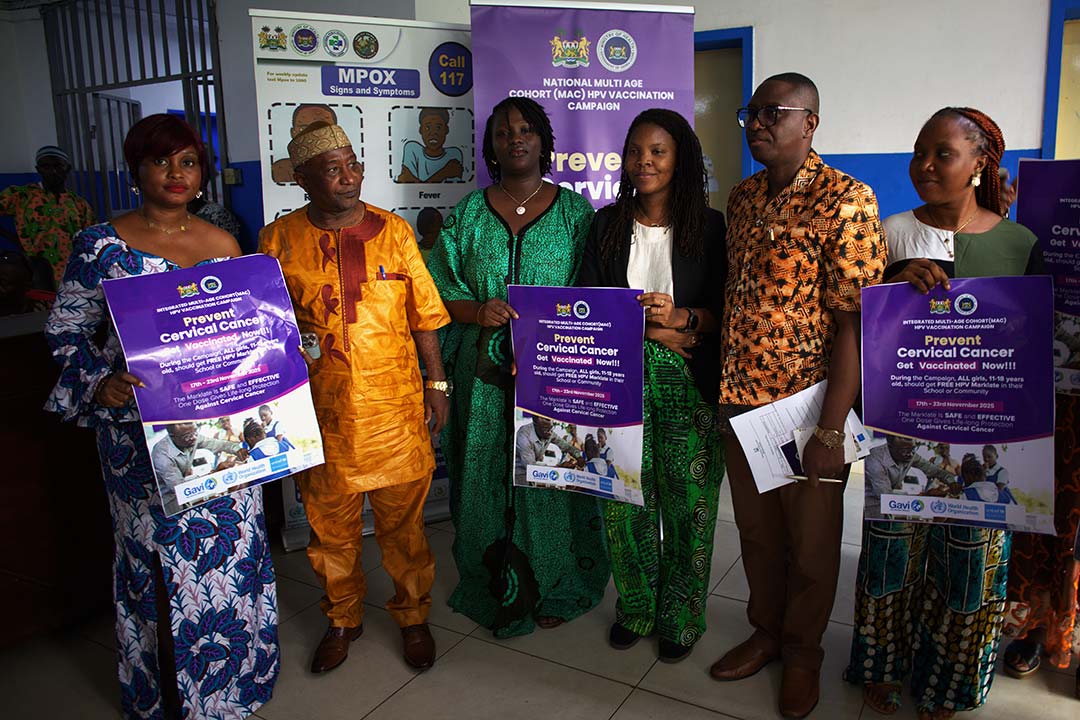
Sierra Leone health workers hold HPV vaccine posters in Freetown ahead of the vaccination of in-school and out-of-school girls between the ages of 11 and 18. Credit: Saidu Bah
An ambitious November campaign to protect a million girls with the HPV vaccine could mark a historic inflection point in Sierra Leone’s journey to elimination of the all-too-common cancer
Announcements
IFFIm impact: HPV
IFFIm has provided US$ 144 million to Gavi for its HPV programmes- representing 20% of its total resources for the vaccines.
“Cervical cancer is preventable, but it’s a disease that has taken too many of our mothers, our daughters, our sisters and our friends,” said Dr Jalikatu Mustapha, Sierra Leone’s Deputy Minister of Health 2. The lost women include Dr Mustapha’s own grandmother, who died of the cancer – the country’s most common, and second-deadliest, according to 2022 data – 19 years ago.
“Every year, we diagnose about 500 women with cervical cancer, and we lose more than 70% of them. That is a very high fatality rate, it’s very bad and unacceptable for us as a country,” she said.
Dr Mustapha spoke to VaccinesWork as the country prepared to launch what she termed “a massive campaign”: a week-long sprint, beginning on 17 November to vaccinate about a million girls against the cancer-causing human papillomavirus (HPV).
The HPV vaccine was piloted in Sierra Leone in 2013, with a Gavi-supported national roll-out beginning in 2022. “Since then, we’ve become even better at it,” said Dr Mustapha. But with President Julius Maada Bio calling for the elimination of cervical cancer – a disease that is 90% preventable by vaccination – an ambitious push was called for.
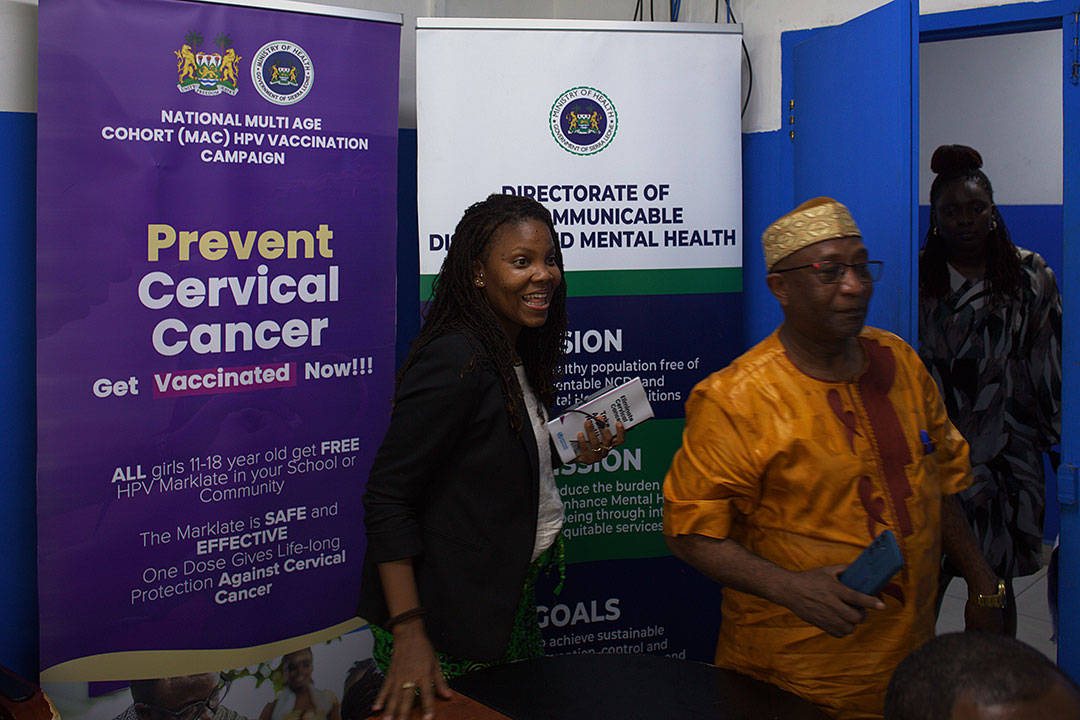
Credit: Saidu Bah
Some 1.3 million doses of the jab were on standby in the nation’s fridges, earmarked for girls aged 11 to 18. The epidemiological justification for that age range, explained Dr Mustapha, is that reaching girls before sexual activity exposes them to the virus maximises the vaccine’s efficacy. The virus is extremely common, causing cancer in a minority of cases, typically when a woman reaches her 30s, 40s, or 50s. A single dose in adolescence can all but rule out that risk.
“This vaccination we are doing now, the benefits and impacts will be seen within the next 10, 20, 30 years from now, when we get a massive reduction in our cervical cancer cases,” Dr Mustapha said.
Schools stood at the ready to host a large number of the campaign’s vaccination sessions, with Abubakar Kuyateh, Director of Programs at the Ministry of Basic and Senior Secondary School Education, saying, “I want to assure the health workers that the Ministry of Basic Education is ready to collaborate for a successful implementation of the vacation campaign.”

Credit: Saidu Bah
The campaign got underway, raising wistful thoughts, for some, of a kind of safety their generation missed out on. “If this vaccine was available when I was growing up as a child it could have saved me, but currently I’m still in treatment at hospital in Freetown,” Beatrice Kindawa, a 56-year-old cancer patient told VaccinesWork. “I will encourage young girls to take the vaccine earlier, so as to protect themselves from this dangerous cervical cancer disease,” she added.
Women like Kindawa, born too soon to benefit from Sierra Leone’s vaccination programme, will benefit from regular screening. Early-stage cancers are easier to combat with surgery and treatment than advanced cases, and the Ministry of Health is working to make life-saving check-ups easier to access.
“We’ve set up cancer survival treatment centres and 24 active screening sites to help the patients get access,” said Dr Mustapha. “Seven are in the western area of the capital Freetown and the others across the country.”
 | This article is republished from VaccinesWork under a Creative Commons license. Read the original article. VaccinesWork is an award-winning digital platform hosted by Gavi, the Vaccine Alliance covering news, features and explainers from every corner of global health and immunisation. |
Share this article
Restricted Access Library
 The material in this Restricted Access Library is intended to be accessed only by persons with residence within the territory of a Member State of the European Union and is not intended to be viewed by any other persons. The material in this Restricted Access Library is provided by IFFIm for information purposes only and the materials contained herein were accurate only as of their respective dates. Certain information in the materials contained herein is not intended to be, and is not, current. IFFIm accepts no obligation to update any material contained herein.
Persons with residence outside the territory of a Member State of the European Union who have access to or consult any materials posted in this Restricted Access Library should refrain from any action in respect of the securities referred to in such materials and are otherwise required to comply with all applicable laws and regulations in their country of residence.
By clicking Access restricted content: DYNAMIC-LINK-TEXT I confirm that I have read and understood the foregoing and agree that I will be bound by the restrictions and conditions set forth on this page.
The materials in this Restricted Access Library are for distribution only to persons who are not a "retail client" within the meaning of section 761G of the Corporations Act 2001 of Australia and are also sophisticated investors, professional investors or other investors in respect of whom disclosure is not required under Part 6D.2 of the Corporations Act 2001 of Australia and, in all cases, in such circumstances as may be permitted by applicable law in any jurisdiction in which an investor may be located.
The materials in this Restricted Access Library and any documents linked from it are not for access or distribution in any jurisdiction where such access or distribution would be illegal. All of the securities referred to in this Restricted Access Library and in the linked documents have been sold and delivered. The information contained herein and therein does not constitute an offer for sale in the United States or in any other country. The securities described herein and therein have not been, and will not be, registered under the U.S. Securities Act of 1933, as amended (the "Securities Act"), and may not be offered or sold in the United States except pursuant to an exemption from, or in a transaction not subject to, the registration requirements of the Securities Act and in compliance with any applicable state securities laws.
Each person accessing the Restricted Access Library confirms that they are a person who is entitled to do so under all applicable laws, regulations and directives in all applicable jurisdictions. Neither IFFIm nor any of their directors, employees, agents or advisers accepts any liability whatsoever for any loss (including, without limitation, any liability arising from any fault or negligence on the part of IFFIm or its respective directors, employees, agents or advisers) arising from access to Restricted Access Library by any person not entitled to do so.